Takht-e Rostam Guide: Samangan's Rock-Cut Buddhist Stupa
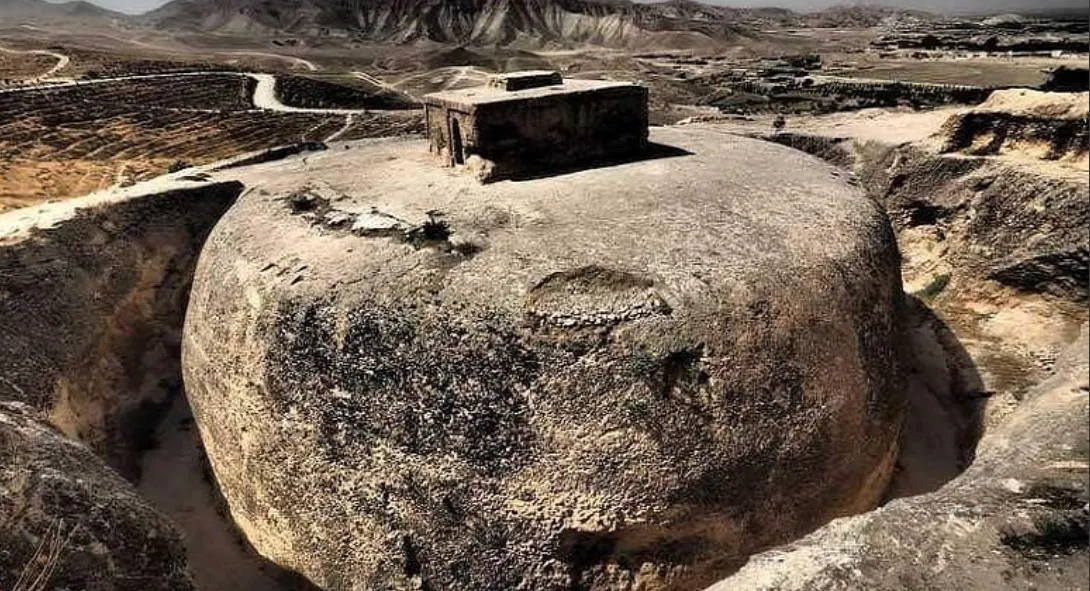
Two hours from Mazar-e-Sharif, near the town of Aybak, a Buddhist stupa stands in a trench cut straight down into the rock. Takht-e Rostam is one of the best-preserved Buddhist monuments left in Afghanistan, and one of the easiest to add to a trip in the north.
Takht-e Rostam is a Buddhist stupa and monastery carved out of the bedrock in the 3rd–4th century AD, 2 km south of Aybak (Haibak) in Samangan province, Afghanistan. It is about two hours by road from Mazar-e-Sharif, so most people visit on a day out from Mazar. Spring and autumn are the best seasons.
What is Takht-e Rostam?
Instead of being built up from the ground, the stupa was carved out of a hilltop: a deep circular trench was cut around it, leaving the dome standing in the middle with a small square block, the harmika, on top. Around the trench, monks cut a monastery into the rock: five chambers, two of them sanctuaries, and small cells for meditation. One room has a domed ceiling carved with lotus leaves.
What to see at Takht-e Rostam
- The stupa. Walk the trench around it and look up at a monument cut from a single piece of rock.
- The monastery caves. Step into the chambers and cells around the trench; bring a torch for the darker rooms.
- The lotus ceiling. The carved dome with its lotus-leaf decoration is the finest detail in the complex.
- Aybak town. A small provincial town on the Kabul–Mazar road, with a bazaar for a tea stop.
History and the legend of Rostam
The monastery dates from the 3rd–4th century AD, when Buddhism flourished in this region. After Islam arrived its original purpose was forgotten, and people linked it to the Shahnameh, the Persian Book of Kings: here, the story goes, the hero Rostam stayed with the king of Samangan and married his daughter Tahmina, the mother of Sohrab. That is why it is called Takht-e Rostam, the Throne of Rostam.
How to get to Takht-e Rostam
Takht-e Rostam is 2 km south of Aybak, the capital of Samangan province. Aybak is about two hours by road from Mazar-e-Sharif, which is about an hour from Kabul by domestic flight, and it is also on the main road from Kabul to Mazar over the Salang Pass. Most visitors come on a day out from Mazar.
Best time to visit Takht-e Rostam
Spring and autumn are the most comfortable. Summers on the northern plains are very hot and winter days are short and cold, though the site can be visited all year.
Permits and entry fees at Takht-e Rostam
Visitors need a provincial permit for Samangan from the Ministry of Information and Culture office, and there is a small entry fee at the site. Both are included in our tour price, and your guide handles the paperwork.
Practical tips for visiting Takht-e Rostam
- Bring a torch or phone light for the darker monastery chambers.
- Wear shoes with good grip; the rock floors and steps can be uneven.
- Combine it with Mazar-e-Sharif and old Balkh for a fuller picture of northern Afghanistan's history.
- Ask before photographing people in Aybak.
Takht-e Rostam is an easy and memorable addition to a trip to northern Afghanistan. Our 3-day Takht-e Rostam & Mazar tour combines it with the Blue Mosque and old Balkh. Tell us your dates on WhatsApp.
Sources: Wikipedia: Takht-e Rostam · Atlas Obscura: Stupa of Takht-e Rostam
Questions about visiting Takht-e Rostam
Where is Takht-e Rostam?
2 km south of Aybak (also spelled Haibak), the capital of Samangan province in northern Afghanistan. It is about two hours by road from Mazar-e-Sharif.
How old is Takht-e Rostam?
The stupa and monastery were carved out of the rock in the 3rd–4th century AD, when Buddhism flourished in the region.
Why is it called Takht-e Rostam?
The name means "Throne of Rostam". After its Buddhist purpose was forgotten, it was linked to the Shahnameh story in which the hero Rostam stayed with the king of Samangan and married his daughter Tahmina.
Can you visit Takht-e Rostam as a day trip from Mazar-e-Sharif?
Yes. Aybak is about two hours from Mazar by road, so the drive there and back and a visit of an hour or two fit in one day. Al Hamid Tour and Travel's Takht-e Rostam & Mazar tour takes 3 days, with the Blue Mosque and old Balkh.
Samangan and Takht-e Rostam tours and prices
Planning a trip? Talk to our Kabul team — we reply fast on WhatsApp.
Plan My Trip